
|
"When the summer sun is burning and the days are filled
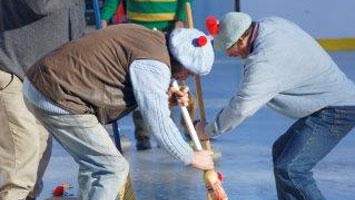
with heat, Curling HistoryCurling, which can be likened to bowls on ice, is one of the rarer New Zealand sports. Introduced from Scotland by gold miners who came to Otago in the early 1860s it became a pastime of the miners when the severe winters in the interior produced sharp and continued spells of frosty weather, putting a temporary check on gold mining, and providing ideal conditions for curling. Curling stones, imported from Scotland, are carefully shaped and smoothed pieces of granite fitted with a handle which can be changed from top to bottom. The reason for this is that the two sides are prepared differently for varying ice conditions. The stones vary in weight, although an average would be about 12kg. If they are not broken they will last for generations. The object of the game is to get as many of your team's stones closer to the tee than your opponents'. The curler slides the stones as close as possible to a jack. The tee, which is in the centre of the circle, need only be a mark on the ice. Each stone that is inside a previously marked out area called a "house" (the circle scratched in the ice with a 7 ft stick ) and closer to the tee than your opponents' counts as one point. This constitutes an end. Play is then resumed in the opposite direction by the lead of the winning team. The final score is determined after 21 ends have been played - the highest scoring team being the winner. Stones travelling down the ice have a tendency to curve or "curl", hence the name curling. By skilful propulsion and the use of the natural imperfections, or bias, in the ice, the stones can be manoeuvred towards the tee and at the same time the other stones avoided. A unique part of curling is the concept of sweeping. Players vigorously sweep, or brush, the ice in front of the stone to keep it moving. The friction caused by the sweeping polishes the ice by briefly heating the surface, which makes the stones travel farther and straighter. ( for a comprehensive understanding of curling rules and techniques click here or for a curling glossary click here) "He positioned his broom and he asked for 'tee
weight'.
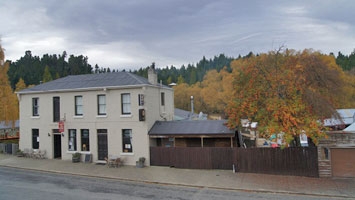
The ClubsThe oldest club in existence, dating from 1795, is the Royal Caledonian Curling Club, the mother club of clubs in Scotland, Canada, the United States and Sweden as well as in New Zealand The first club in New Zealand was the Haldon Club in the Mackenzie Country, but it only lasted for a few years. The Dunedin Club was formed in 1873, the first Secretary/Treasurer being Mr T Calendar. After a public meeting on May 31st 1878 held in the Naseby Town Hall The Mt Ida Curling Club was formed. The first challenge between Dunedin and Mt Ida took place August 4th 1881. Mt Ida won both games and the match and the medal for which the competition had taken place, sent out by the Royal Caledonian Curling Club for competition among New Zealand Clubs. "The Nasebyites, although gratified at the local teams success, could not help but admire the perfect good nature with which the visitors accepted defeat which was nonetheless hard on them, having travelled one hundred miles to receive it. Thus the first official match in the southern hemisphere had been accomplished in Naseby .." (read extract W.J. Inder account from '100 years of curling at Naseby') Late in the 1882 season two new clubs were welcomed in Central Otago ( Kyeburn and Clyde). On 2nd October 1883 six members resigned from the Mt Ida Club, and formed a new club - the Otago Central Club. An adage was to stick with these two clubs for many years; the Otago Central Club were referred to as the "Moleskins" and the Mt Ida the "Boiled shirts", i.e. Miners and Professionals. This was a jocular way of describing the members of each club. 1902 another breakaway from Mt Ida saw the Naseby Curling Club formed. Today there are fourteen clubs in the Naseby Curling Council. Five are based in Naseby itself being Mt Ida (Boiled shirts), Central Otago (Moleskins), Kiwi (Sticky beaks), Naseby (Naseby) and Pioneer ( Ladies). Balmoral, Dunedin, Garibaldi, Hamiltons, Kyeburn, Ranfurly, Serpentine, Wedderburn, and Windwhistle make up the rest in the district. Tradition and passion for the game is as strong as ever. Clubs base their clubrooms in the local Hotels of the area. Today most of the trophies competed for in the region reside on the top shelf of the local pubs. But make no mistake, the Curling Silverware in the Maniototo is a passionately coveted commodity. And none more so than curling's Holy Grail, 'The Baxter's Cup'.
The BonspeilEach year, if conditions are favourable, there is one bonspiel, as a meeting of the clubs is known, called when the ice is right. It must be thick enough to hold the weight of many players standing close together, and must be smooth. Clubs usually have 10 members, so that two four-man rinks can be entered in the bonspiel. Bonspiels have been few in recent as they must be played on natural ice and the cold Maniototo winters are not as regular as they once were. New Zealand is the only country in the world to still play the traditional game using 'crampits' (a steel grid set on the ice for traction -as pictured), most other countries now play a version of Curling known as 'Hack Curling' and at the last Winter Olympics, Hack Curling as a sport was introduced for the first time. Behaviour on the ice, the ethics of the game, and the observance of the rules are governed by a very strict code. A tradition occurring only after a Bonspiel, is the 'Curlers Court', where new players are inducted into the Curling brotherhood in a secret ceremony, and the traditional Curlers dinner of 'Beef and Greens' is served. The good fellowship traditions and friendly competition ensure that the popularity of the game will continue for many more years. It is said that the warmth of a "nip" while wintry winds blow produces the comradeship in the game that so endears it to its devotees. Until recently, New Zealand has been isolated from the rest of the curling world, so the traditions, lore, and spectacle of these occasions are virtually unchanged from the original customs brought to NZ by our Scottish forefathers well over a century ago.
The Baxter's CupDonated by David Baxter of Dunedin to Dunedin Curling Club in 1882, The Baxter Cup is the major trophy contested for by all Naseby Council teams. It is believed to be the oldest sporting trophy still competed for in NZ. First brought to Naseby in 1900 and won on that occasion by Otago Central Curling Club, it is as keenly sought a prize today as it was then. Bonspiel conditions are not as prevalent as they once were. As such the opportunity to covet this trophy is rare. Otago Central Club are the current holders.
Maisey StoupMrs Maisey, who presented the Maisey Cup to Mt Ida in in 1891, also made a further presentation being a beautiful silver coffee stoup, to the Naseby Curling Club, who in turn put the trophy forward for competition between the local clubs. The Stoup was first retained bt Mt Ida and then put up annually as a Champion points Trophy. Unfortunately it was lost in a fire in 1957 and was then replaced by the Maisey Cup, which is competed for today as keenly as ever.
President's CupContested by all Naseby Curling Council member teams, on the same day, club presidents skip their teams. Requires natural ice, called when same is available.
Hore CupDonated by the Hore family. Played for on a round robin each Monday night for six weeks by ten teams of the Naseby Curling Council.
Dowse TrophyDonated by former Reid Farmers stock agent. Played as knockout each Thursday by sixteen Naseby Curling Council teams.
Umbers TrophyMemorial trophy to Constable Peter Umbers contested between NZ Police and Manitototo runholders. Police not yet won it.
Brown Trophy 2000donated by Kevin Brown in memory of his uncle and father who owned the dam where the rink now is. Contested by the five Naseby curling teams. The three most important games contested between the clubs in the Naseby Curling were at that time the same as today, being the Baxter's Cup, the Presidents Cup, and the Maisey Stoup.
Idaburn DamThe Idaburn Dam was built in 1931 for the purpose of irrigation and has a holding capacity of 23 million cubic metres. Serving six farmers, it irrigates 230 hectares with 11.7km of main races and 1.9km of distributary races. The Idaburn Dam is a popular site for the winter sports of ice-skating, ice hockey and curling.. It is the venue for the national Bonspiel (a tournament for all curling clubs). Fishing for Trout and Perch in summer and the Brass Monkey Motorcycle Rally in deepest winter are other pastimes at the dam. |